Logos Testnet v0.1: A Convergence Milestone
The first iteration of a unified, modular stack to revitalise civil society.
Logos


Today marks a defining moment for Logos with the launch of testnet v0.1; not as a traditional release, but as a convergence milestone and a significant step toward a socio-economic system powered by private-by-default infrastructure.
For the past several years, Logos has been building the individual components of a technology stack designed to revitalise civil society: consensus, execution, networking, storage, and messaging. All protocols have been developed independently, with their own roadmap and validation process, but with mechanical symphony in mind. Testnet v0.1 is the first time these systems are packaged together into a unified, modular stack and made available for developers to run and experiment with.
Testnet v0.1 is focused on backend validation and module integration. It is designed to stress test infrastructure, expose APIs, and verify how protocols interact under real network conditions.
This first version of the testnet is purely an initial architecture for the unified Logos stack; future releases will introduce more functionality and improvements.
Developers can start experimenting with testnet v0.1, explore sample applications, view RFPs, and submit ideas and proposals on the new Logos Builder Hub now.
A modular stack, private by default
The Logos tech stack is organised into distinct layers, each with a clear responsibility. Each layer was developed with specific deliverables for testnet v0.1, and together they prove an end-to-end vertical system behaviour for the first time. Two demo apps have been developed to showcase how the modular system can function (more below).
Logos “Kernel”
At its foundation sits liblogos — a microkernel-like foundation responsible for the minimal primitives required to run decentralised systems. In its current state, the “kernel” is operational and able to manage all layers of the stack. For example:
- `liblogos` loads modules from GitHub (for now; in future, the plan is to load modules from Logos Storage).
- Logos Basecamp hosts module UIs.
- Operators can run a Logos node and choose which modules they would like to install and manage.
- The new logos-module library and CLI tool abstract module interaction.
Networking Layer
Above the “kernel” is the networking layer. This layer handles peer discovery, connection management, and privacy-preserving communication. It enables nodes to find one another, establish secure channels, and route messages.
For testnet v0.1, the networking layer is operational in its early form, with plans to update it in the future:
- Mixnet and POCs are usable, but in development.
- Capability discovery is active (although in early stages of development).
Modules
On top of the networking layer sit modules – pluggable, composable components that extend the system with higher-level functionality. Blockchain, execution zones, messaging, storage, and other capabilities are implemented as modules. They are independent but interoperable, communicating through well-defined interfaces exposed by Logos Core.
Blockchain: the following elements of the blockchain are available in testnet v0.1:
- Cryptarchia PoS implemented, with the privacy-preserving element to be added.
- Logos Execution Zone (LEZ) sequencer, indexer, and block explorer with the Bedrock node to enable end-to-end testing.
Messaging: Private communication has been designed into two primary modules:
- Delivery to easily send reliable messages.
- Chat enabling fundamentals for private, secure messaging, including E2EE, perfect forward secrecy, double-ratchet encryption, conversation initialisation, and payload handling.
Storage: Decentralised file sharing with CID-based retrieval.
View all the docs here.
Logos Basecamp
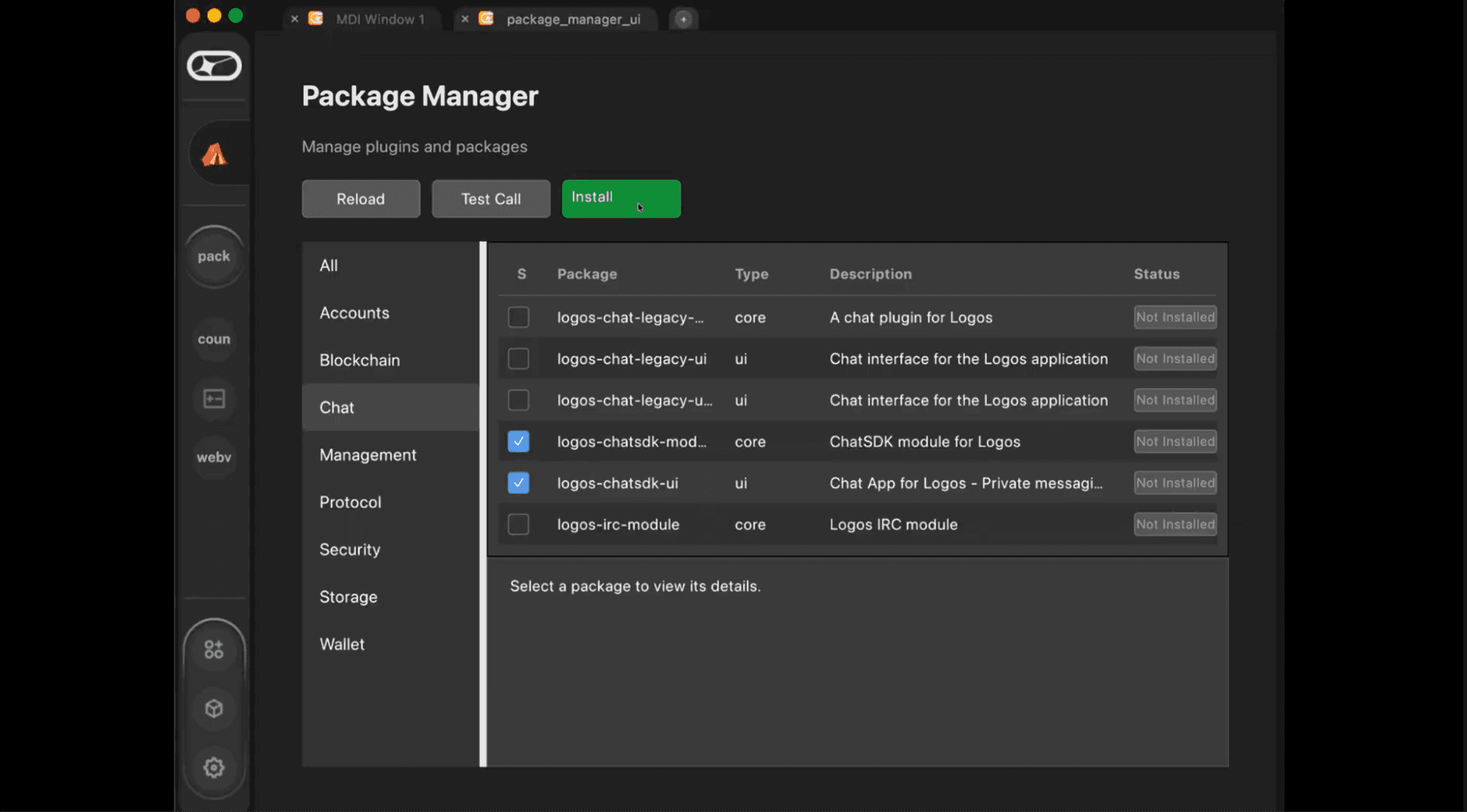
Logos Basecamp is a complete distribution that bundles liblogos, the default modules, and UI packages into a usable product. It allows the user to easily interact with simple apps built on the various modules.
Install the binaries on the new Logos Builder Hub.

Beyond Testnet v0.1 - The roadmap to mainnet
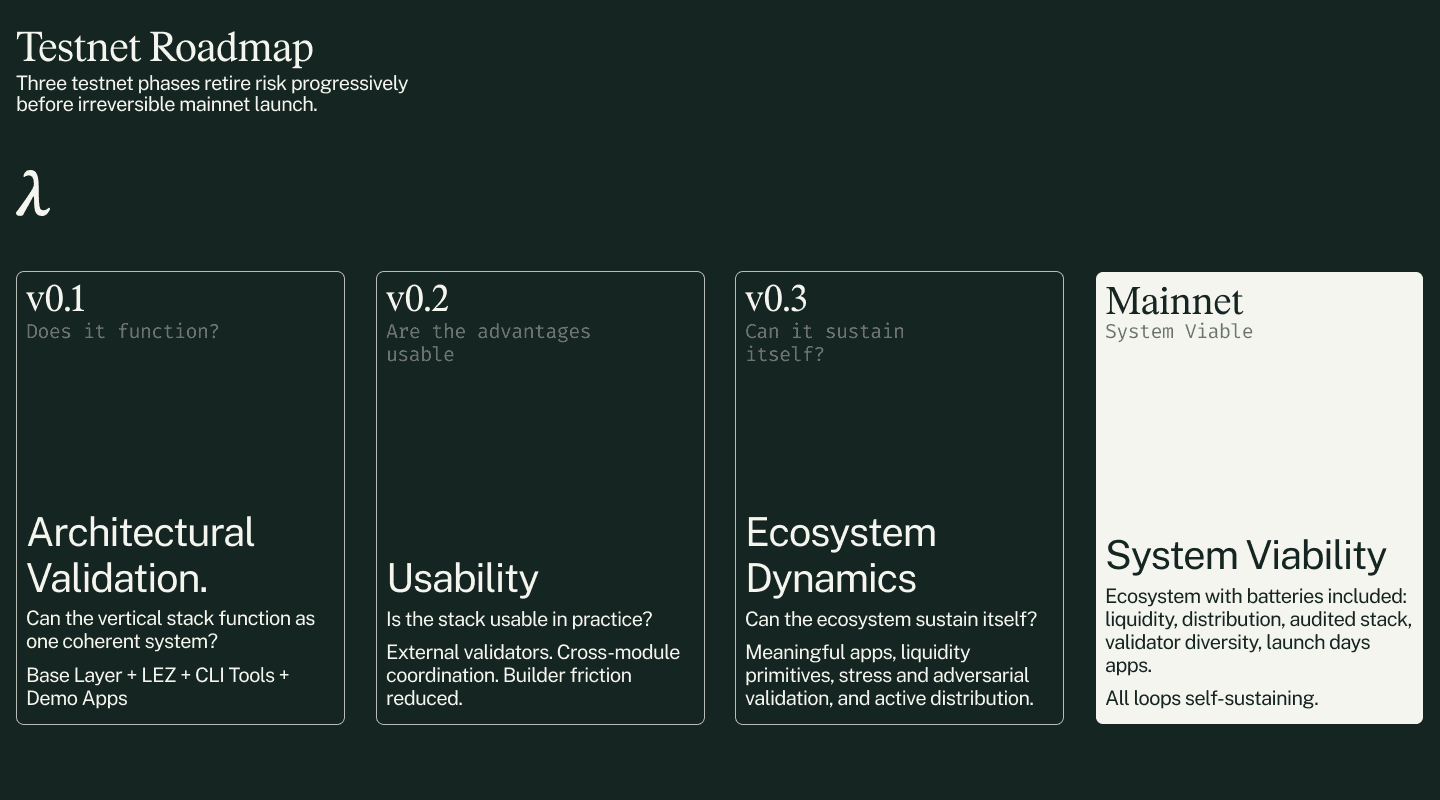
Three testnet phases reduce risk progressively before an irreversible mainnet launch. Each phase is a go/no-go gate in which we do not advance until questions are answered. The following represents the plan, but as with all technology, the roadmap is subject to change.
v0.1: Architectural Validation
The vertical stack operates as one coherent system, but is in its early architecture and will be improved and built upon. The base layer, LEZ, CLI tooling, and demo applications run together in an integrated environment, validating end-to-end behaviour across modules and proving the architecture in practice.
v0.2: Improved Usability
The stack becomes usable in real-world conditions, and new features will be introduced that continue to improve the usability of modules. External validators will participate, cross-module coordination will stabilise, and builder friction will be significantly reduced through improved tooling, documentation, and integration. This version of the testnet will see architectural improvements across the entire stack.
v0.3: Ecosystem Dynamics
The ecosystem will demonstrate sustainability. Meaningful applications will emerge, liquidity primitives will be activated, distribution will expand, and the system will be tested under stress and adversarial conditions.
Mainnet: System Viability
The mainnet will launch with a fully integrated, audited stack. Liquidity, distribution, validator diversity, and launch-day applications will be in place. Core economic and coordination loops will operate as self-sustaining systems.

Demo apps showcasing the stack
Two demo apps have been built by the Logos team to showcase the various modules and interoperability between them.
Atomic Swaps
The Atomic Swaps sample app demonstrates trust-minimised cross-chain exchange between LEZ (λ) and Ethereum using an HTLC-based mechanism. A maker sells λ for ETH, while a taker completes the swap, with built-in refund paths if timeouts occur.
The app integrates the LEZ Wallet, Blockchain module, and Ethereum wallet tooling, showcasing cross-chain coordination through Logos Core. While Ethereum-side activity is publicly traceable, private LEZ accounts protect participant identity, highlighting how Logos combines interoperability with structural privacy.
Multisig
The Multisig sample app enables secure, privacy-preserving shared custody of assets, requiring multiple signatures to authorise transactions. It protects treasuries, team funds, and shared wallets without revealing signers or balances.
The app leverages threshold signatures, zero-knowledge proofs, and privacy-preserving MPC to ensure approvals are verifiable while keeping individual participation confidential. By integrating with Logos Core modules, it demonstrates secure coordination, signer rotation, and ZK-enabled authorisation, highlighting Logos’ ability to support private, multi-party financial interactions for DAOs, corporate treasuries, and collaborative funds.
The Logos Builder Hub
In addition to releasing the Logos Testnet v0.1, the team has introduced the Logos Builder Hub - a hub for developers to start experimenting with the tech stack, download Logos Basecamp, review and start work on new RFPs, and explore and submit ideas they want to see built.
Download Logos Basecamp
Logos Basecamp is a complete distribution that bundles the kernel, the default modules, and UI packages into a usable product. It allows the user to easily interact with simple apps built on the various modules.
Request For Proposals (RFPs)
The Logos RFP programme invites developers and teams to submit proposals to build and launch production-ready applications on the Logos stack. Through milestone-based funding, talented teams can bring their ideas to life, showcase their work to the ecosystem, and deliver real, market-ready apps. The programme supports projects across developer tooling, integrations, and community-focused applications.
View more on GitHub.
Ideas Repo
Along with RFPs, the Builder Hub includes a list of ideas submitted by both Logos core contributors and community members. These are ideas for apps that would be useful for the ecosystem and help deliver on the mission to revitalise civil society. While important to the mission, these are designed for inspiration and connection over funding.
View more on GitHub.
Logos is pioneering a new era of freedom; join the mission and help build the tools to revitalise civil society.
Discussion
Logos
Logos
Logos
Logos
Logos
Logos
Logos
Logos
Logos
Logos