Logos Testnet v0.1 in Review
What the numbers say about a promising first testnet run
Logos

After much internal testing and improvement, Logos released its first blockchain testnet to the public on 3 March 2026. As the first publicly accessible version of the Logos Blockchain, the testnet was used to discover issues that went unnoticed during testing and to observe how its protocols behave under real network conditions. The first release, dubbed v0.1, coincided with Parallel Society in Lisbon and served as a hands-on entry point for individuals interested in the Logos ecosystem.
All in all, the network held up far better than the team had anticipated. Over the course of a month and a half, the testnet generated over 222,000 transactions, with node operators spanning 29 countries. Logos has now relaunched the testnet as v0.1.2, adding performance improvements and critical fixes.
Statistics from Testnet v0.1
Testnet participants
Due to the privacy properties of the Logos Blockchain’s Cryptarchia consensus, it is impossible to directly track node operators. Despite this, IP addresses can be used as a proxy measure for participation, without revealing any individual operator’s contributions.
According to this measure, over 70 distinct IPs running 357 nodes were recorded by the end of Testnet v0.1, between 3 March and 14 April 2026. Node participation was tracked through gossip logs, which recorded individual nodes self-reporting their peer IDs. The Gantt chart in Figure 1 shows the uptime of participating nodes over the last 11 days of Testnet v0.1 (3–13 April).

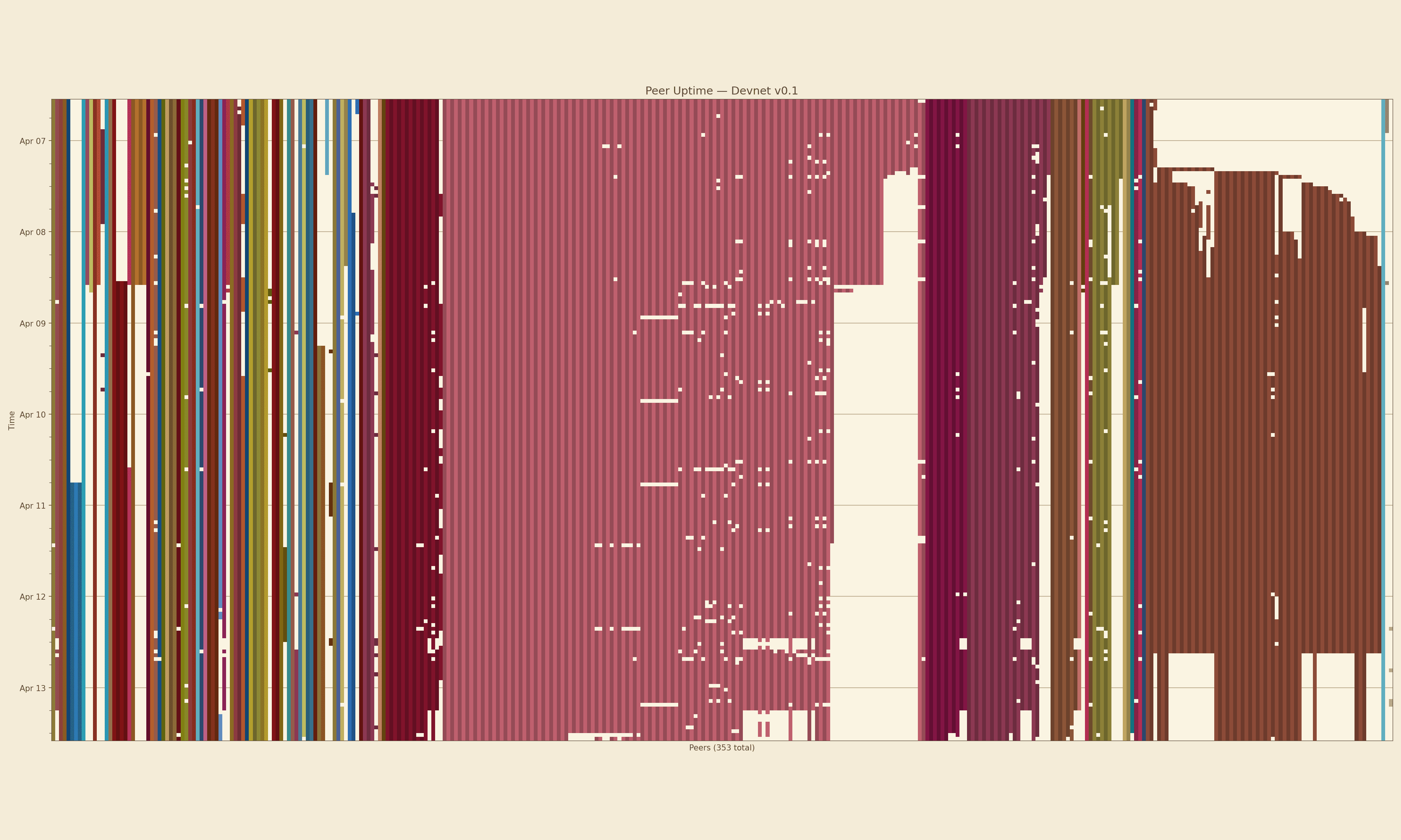
The chart above colour-codes each peer row by IP, making it possible to visually identify clusters of nodes likely operated by the same individual or organisation. A few observations stand out:
- Most nodes remained online for the majority of the observation period.
- Several large colour bands indicate that the majority of nodes were run by a few operators.
- The right section shows a large cluster of nodes from a single operator that came online around 8 April.
It should be noted that the chart lists 363 node IDs, rather than 357. This discrepancy likely reflects nodes that cycled through multiple peer IDs or IP addresses during the run.
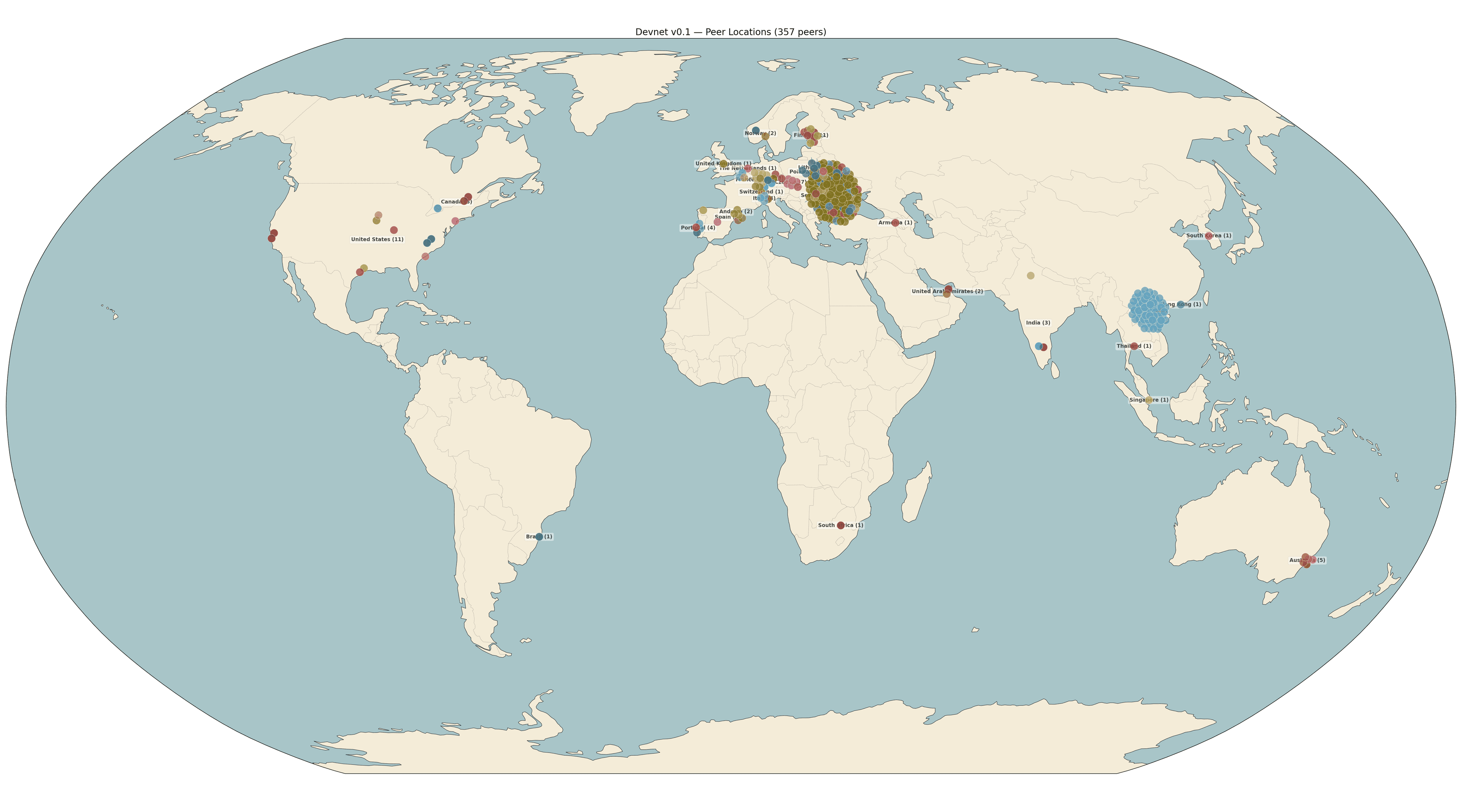
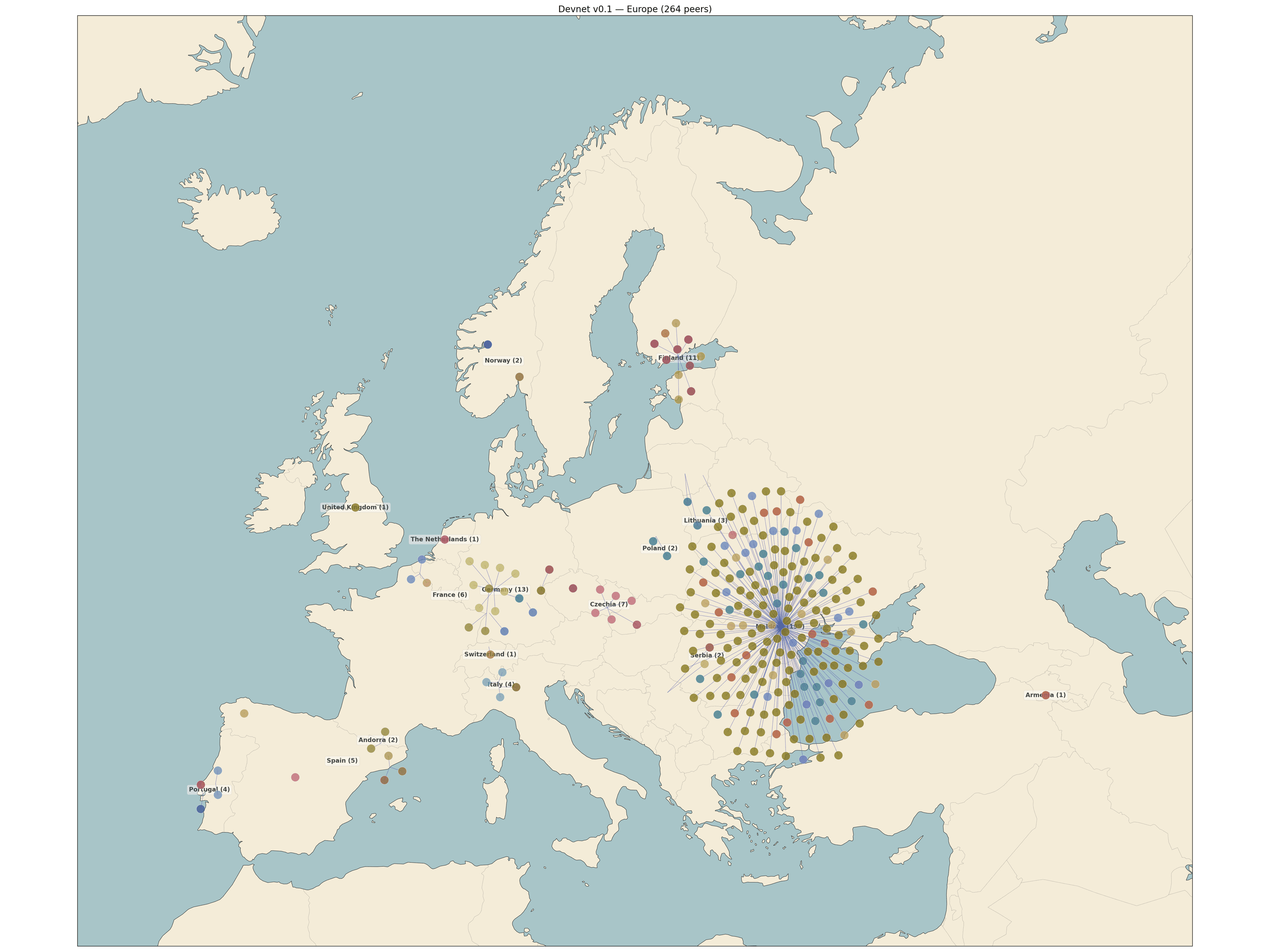
Geographically, Europe dominated participation with 264 nodes (74% of the total). The largest European contributors were Moldova (182 nodes), Germany (13), and Finland (11). Outside Europe, Vietnam was the largest contributor (63 nodes), followed by the United States (11) and Australia (5). This distribution is shown below in Figures 2 and 3.


Block times
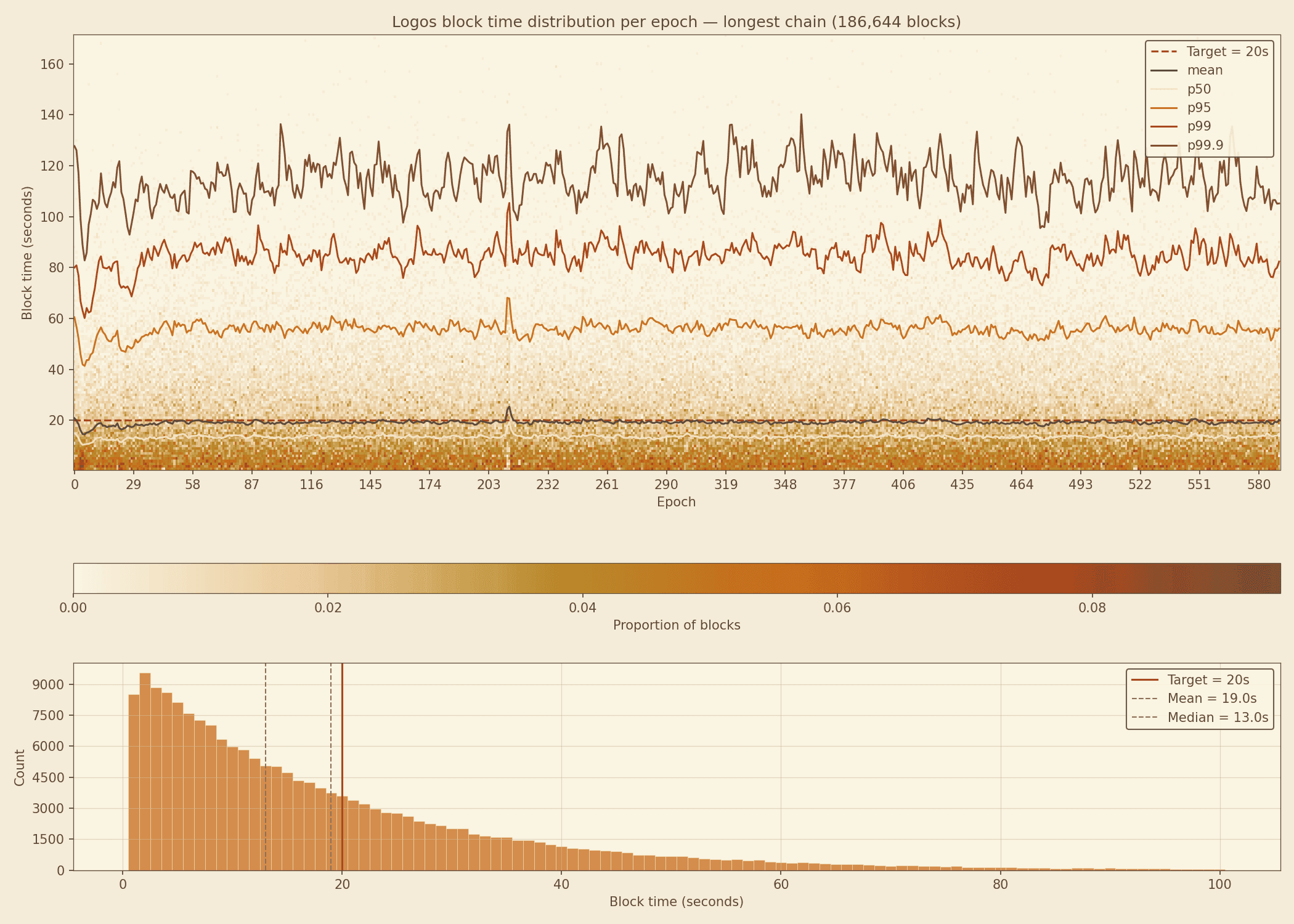
In terms of consensus, the testnet had an average block time of 19.0 seconds across 186,644 blocks on the longest chain, compared to the target block time of 20 seconds. This result was expected: given the overhead introduced by network inefficiencies, a slight downward drift from the target is expected and acceptable. This finding can be seen in the Figure 4 charts below.

Transactions
The longest chain contained 186,645 blocks over 984.3 hours of runtime, with 54,905 of these blocks containing transactions. Looking inside those blocks, the testnet generated 222,104 total transactions over its lifetime, of which:
- 3,996 were faucet transactions
- 52,511 were inscriptions (nearly all from the Logos Execution Zone)
- 169,593 were token transfers
Transaction statistics for the longest chain are shown in the charts in Figure 5.

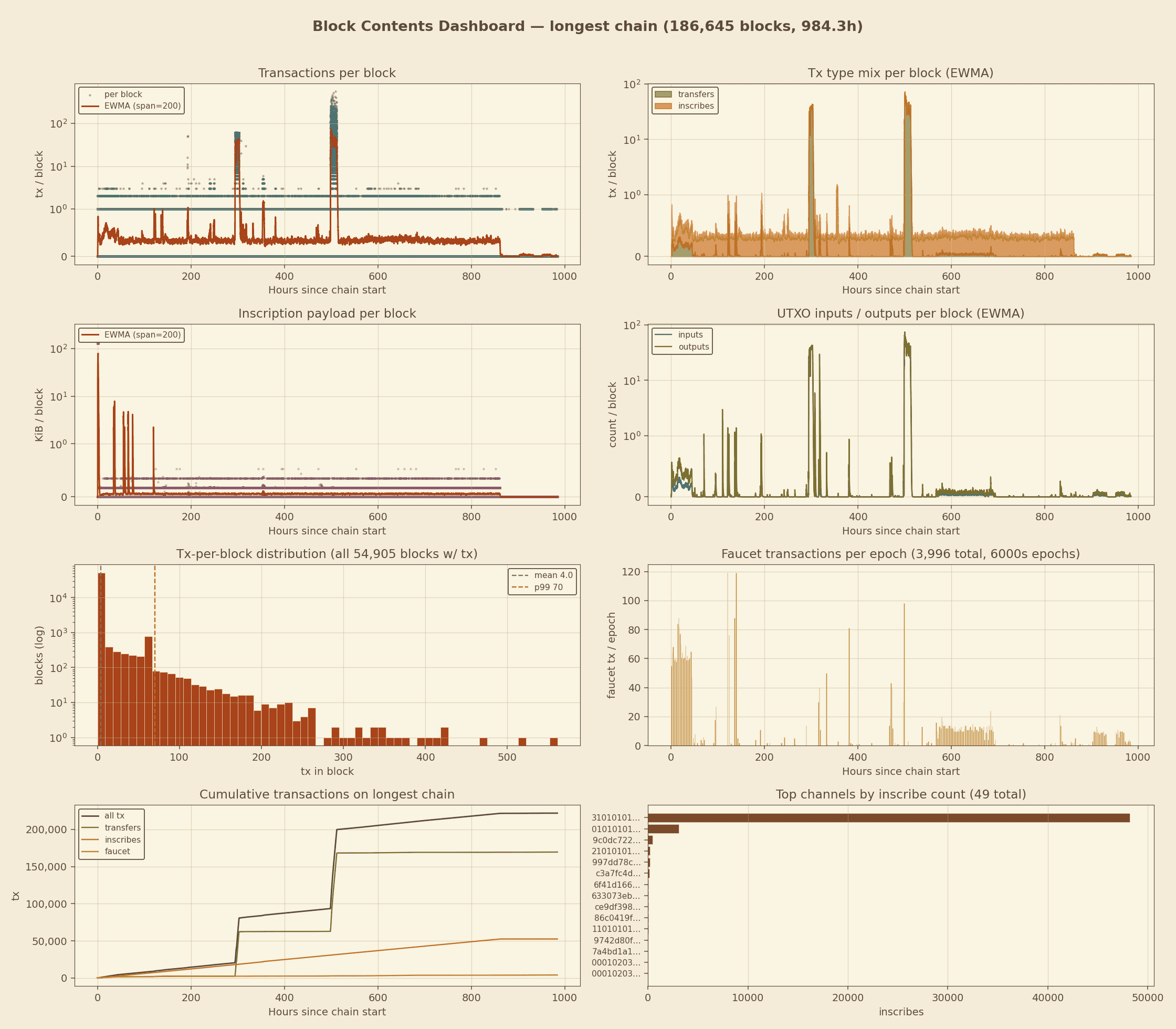
The mean transaction density across blocks with transactions was 4.0 tx/block, with a p99 of 70 tx/block, indicating that during stress periods, some blocks carried well over 70 transactions.
Across 49 total channels, the channel associated with the Logos Execution Zone (LEZ) dominated all others, accounting for approximately 45,000+ inscriptions. This is because the LEZ publishes inscriptions to its channel once every minute, even if the LEZ blocks are empty. Two distinct spikes in transaction throughput correspond to planned stress tests the team conducted during the window.
Issues discovered
The most widely reported friction point for v0.1 node operators was the time required to bootstrap into the network. When a node first joins – or restarts after a period offline – it needs to sync up to the chain tip by downloading and verifying historical block data. In v0.1, this process was not very efficient and was not restartable, meaning that an interrupted bootstrap could force operators to start from scratch. Toward the end of Testnet v0.1, bootstrapping exceeded 48 hours and used more than 20 GB of RAM for some users.
The second major issue was log volume. In v0.1, nodes were writing log files at a rate of several gigabytes per day. On constrained systems such as personal computers or Raspberry Pis, this caused two cascading failures: disks filled up, and in some cases, the resulting full-disk conditions corrupted the node's database state.
Testnet v0.1.2 and a view of the future
The v0.1.2 release, announced on 14 April 2026, is a breaking update; the testnet has been restarted with a new genesis block, requiring node operators to delete their node data before joining. This new release contains fixes for the main issues discovered in v0.1, namely, long bootstrap times and large log files, as well as other improvements.
These improvements pave the way toward v0.2: the next major testnet version, which will support additional proposer privacy via the Blend Network, decentralised Zone sequencing, and token bridging to and from Zones.
In sum, the Testnet v0.1 run was remarkably stable and successful. If you are interested in advancing the Logos vision and revitalising civil society with truly decentralised technology, there’s no better time than now to spin up a node.
We're building infrastructure to revitalise civil society. We need developers, designers, writers, and activists to help shape it.
Discussion
Dr. Corey Petty
Dr. Corey Petty
Logos
Logos
Logos
Logos
Logos
Logos
Logos
Logos
Logos
Logos
Logos