Logos Dev Update: What’s Next for the Technology Stack in 2026
Looking back on 2025’s technical achievements as we head into another packed year of protocol development and movement building
Logos

2025 marked a turning point for Logos as a technical project.
What had previously existed as a collection of related but independently evolving protocols came together into a single, coherent stack, with a clear identity, shared architecture, and a more deliberate focus on the developer experience.
Logos underwent a substantive shift towards action, both as a movement and a technology stack, which includes a deeper shift in the way protocols are built, documented, and made available to be used.
Now, Logos aims to deliver a completely integrated foundational architecture that can support privacy-preserving decentralised applications in real-world conditions.
As part of the consolidated Logos movement and tech stack, further technical updates on Logos messaging, blockchain, and storage will be published on Logos platforms, including here on the Logos Press Engine.
For developer-focused highlights on X, please follow Logos Tech. For broader updates on the Logos movement as a whole, stay tuned to the main Logos account. To recap 2025 from the perspective of Logos, the social movement, read this article.
Consolidating the Logos stack

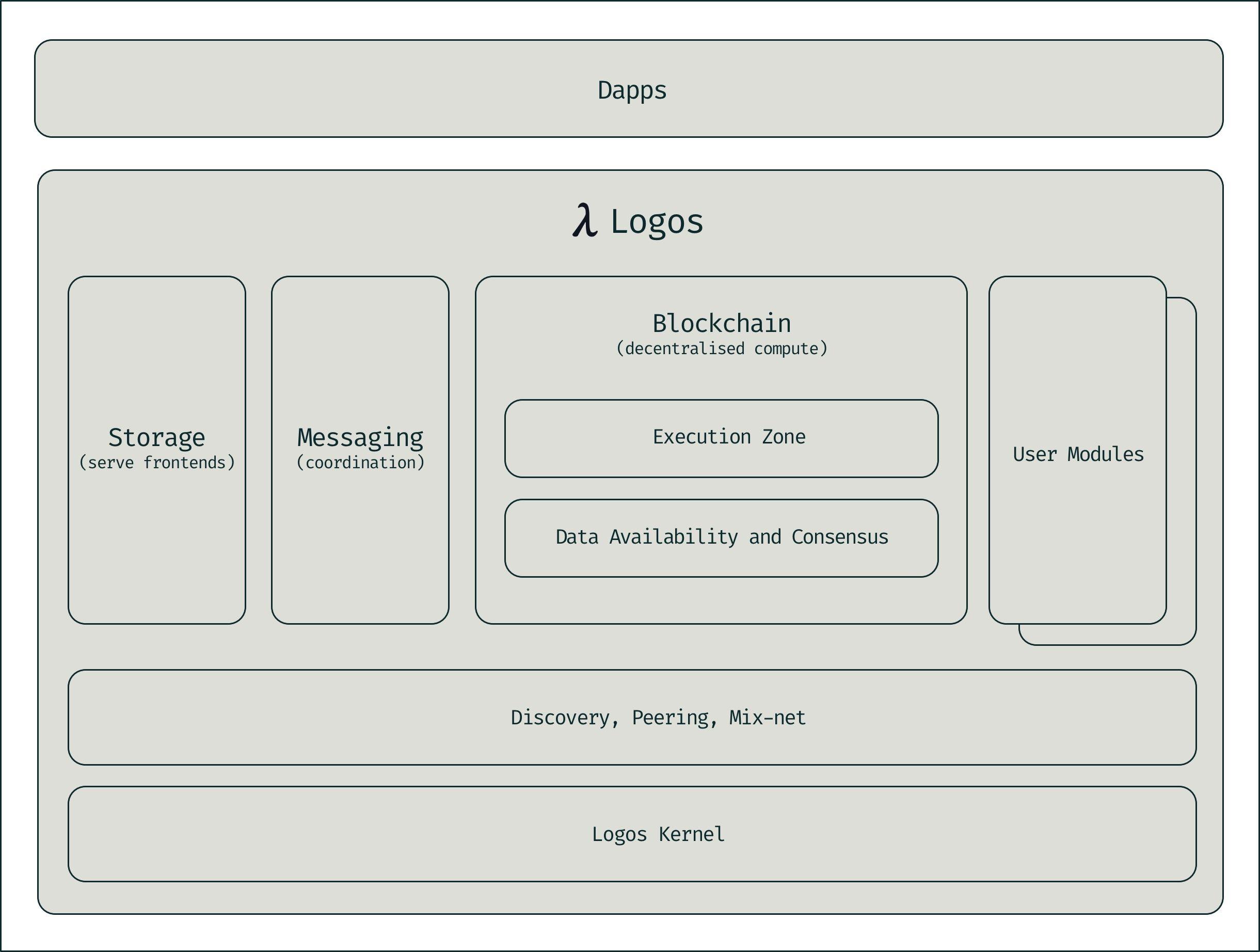
At the start of 2025, the core technologies that now make up Logos were known as Codex, Nomos, and Waku. Each had its own repositories, documentation, and community touchpoints, and each addressed a different pillar of the decentralised stack.
By the end of 2025, these components had been .. This consolidation brought clarity to both architecture and purpose.
- Messaging, previously Waku, now forms the private, peer-to-peer communications layer.
- Storage, previously Codex, provides durable, censorship-resistant data availability.
- Blockchain, previously Nomos, serves as the privacy-preserving Layer 1 that anchors execution, settlement, and coordination across the stack.
For developers, this shift matters because it reframes Logos as a unified ecosystem rather than a set of standalone tools. The stack is private by default and modular by design, with work beginning last year on a plugin-based runtime for decentralised applications to use Logos messaging, storage, and execution modules without centralised dependencies.
Alongside the technical unification, work began on merging websites, developer documentation, and community spaces. This process is ongoing, but the goal is clear: a predictable and navigable entry point for contributors, with consistent terminology and a shared source of truth.
We’ll be adding to our documentation over the coming months to make sure that running, building on, and contributing to the Logos technology stack is as easy as possible.
We remain committed to delivering a private-by-default decentralised stack to defend civil liberties at scale and revitalise civil society, and we welcome builders to join the open-source Logos movement and help create the tools that will deliver a better, more hopeful future for society.
Logos Core: A modular runtime for developers
Following consolidation, attention turned to the question of how developers actually build on Logos
The answer taking shape is Logos Core, a modular, plugin-based runtime designed to unify development and deployment across the network.
Rather than hard coding functionality into a monolithic client, Logos Core allows nodes to dynamically discover and load modules while preserving privacy and minimising metadata leakage.
Modules will enable developers to easily integrate Logos protocols, such as messaging, storage, and blockchain node deployments. However, Logos Core modules are not limited to the Logos stack; developers can also build their own modules for Logos Core.
This allows open-source builders to contribute to a crowd-sourced, community-curated library of plugins that make it easier to build decentralised applications.
This architectural choice is central to the long-term vision of the Logos developer experience. It allows the network to evolve without breaking deployed applications and supports decentralised institutions that can remain resistant to capture over time.
Whether used by small communities or large operators, the same framework applies, and the same guarantees hold.
For developers, this means working with a consistent runtime abstraction, with messaging, storage, and blockchain capabilities exposed as composable modules rather than tightly coupled services.
Messaging
Messaging (previously Waku) is currently the most mature component of the Logos stack, and 2025 saw this set of protocols continuously refined, with several protocols adopted by prominent projects.
Messaging saw adoption across production and experimental systems, including integrations with Safe Harbour for decentralised multisig and Threshold Access Control (TACo) for decentralised encryption. Logos messaging is also used by the Status app, and this deployment was greatly improved with additional features and made more robust over the course of 2025.
These integrations demonstrate that while the messaging protocols of the Logos technology stack continue to be built out, they are already capable of supporting scalable, privacy-preserving communications and digital interactions in existing applications with active user bases.
Throughout the year, the messaging protocols evolved through ongoing research and implementation work. Work on Rate Limiting Nullifiers proceeded apace, with the technology being tightly integrated to secure the network against spam and abuse without relying on accounts or fees.
Alongside this, early work began on incentive design for light clients, recognising that sustainable, scalable p2p messaging requires mechanisms that align participation with resource usage.
Parallel to the core messaging work, Logos now also operates a component called AnonComms, which focuses on reducing metadata leakage through mixnets and capability discovery mechanisms.
Currently, this project’s milestones include building capability discovery over libp2p’s Kademlia DHT, establishing a libp2p-based mixnet with pluggable Sybil and denial-of-service protections, and delivering de-MLS for decentralised group messaging with multiple stewards.
The AnonComms roadmap for the year ahead also includes work on a privacy-preserving payment protocol that leverages the Logos blockchain to enable mostly offchain payments to service providers, as well as improvements to Zerokit and the delivery of an RLN prover to support gasless Layer 2 transactions on Status Network.
Storage
Storage (previously Codex) revisited its core design in 2025, as it was tightly integrated into the wider technology stack, with its central goal now being to deliver node-side content storage and retrieval functionality.
Following earlier experimentation, including work with protocols such as BitTorrent, the team stepped back to reassess what a durable, decentralised storage network should look like when aligned with the broader Logos vision.
The emphasis shifted towards robustness, censorship resistance, and developer usability, rather than maintaining a testnet that no longer reflected the desired architecture.
As a result, the existing testnet was deliberately paused while the protocol design is being revisited to fit the scope of the protocol within Logos.
The goal of this change is to realise a more fundamental alignment between storage, messaging, and the blockchain layer, ensuring that developers can rely on a consistent, dependable, censorship-resistant architecture across the stack.
Blockchain
Logos blockchain (previously Nomos) development in 2025 focused on enabling the foundations required for the upcoming testnet, as well as facilitating the operation of the wider Logos stack and node software.
Significant progress was made on the protocol’s core milestones last year, providing the team with the foundation to align more with the broader aims of the Logos movement and work on delivering a testnet.
The base layer of the blockchain protocol provides consensus, data availability, and settlement, and is designed to offload complexity from higher layers wherever possible.
On top of this sits the Logos State Separation Architecture, or LSSA, which serves as the execution environment for wallets, token operations, and program deployment.
LSSA introduces a clear separation between public and private states while keeping them interoperable. This enables developers to build applications that span transparent and privacy-preserving contexts without needing to manage cryptography directly. Privacy is enforced by the protocol through zero-knowledge proofs, making it a default property rather than an optional add on.
A central focus of this work has been decentralised sequencing. Many Layer 2 systems rely on centralised sequencers, which undermines decentralisation and introduces capture risk.
The blockchain aims to provide decentralised sequencing as a service, allowing sovereign rollups and app chains to avoid running their own consensus while still benefiting from decentralised ordering.
LSSA will be the first consumer of this model, coordinating block proposals and processing blocks from multiple sequencers according to protocol-defined rules.
The first public testnet will be rolled out this year. Sign up now for the node programme and stay tuned to Logos socials and the Logos Press Engine for updates regarding the testnet launch.
Documentation and the developer experience
Alongside protocol development, significant effort has gone into improving the developer experience to encourage more open-source contributions and foster a stronger technical community.
Previously fragmented documentation is being consolidated into a single, coherent structure with consistent naming and navigation.
Public-facing terminology is being unified under the Logos identity, with Nomos becoming Logos Blockchain, Codex becoming Logos Storage, and Waku becoming Logos Messaging. While legacy names may persist in repositories and specifications for some time, future documentation will use the Logos-first naming scheme.
The aim is to provide a predictable onboarding path for both operators and developers, where the documentation accurately reflects the current state of the system and can be trusted as a reliable reference.
In 2026, documentation will be released in phases aligned with project milestones. Operator guides will support those running and maintaining the network, while developer guides will focus on building applications across the messaging, storage, and blockchain layers.
Onward into 2026

2025 was a year of consolidation and intentional action for Logos. The stack became more coherent, the architecture more deliberate, and the developer story clearer.
As Logos moves into 2026, our focus is on delivering functional tools that are easy to understand, use, and integrate into applications that safeguard people’s rights and improve their own lives.
Logos continues to prioritise privacy by default, modularity, and resilience against capture. The coming year will translate those principles into systems that developers can deploy, extend, and rely on with confidence.
Logos needs developers, designers, writers, and all forward-thinkers to join the movement to revitalise civil society. Contribute to the movement today via the Logos Contribute portal and help steer humanity into a future we all want to live in.
Discussion
Logos
Jarrad Hope
Logos
Logos
Logos
Logos
Logos
Logos
Logos
Logos
Logos
Logos
Logos